











Football fans in the Republic of the Congo increasingly use analytical tools to evaluate upcoming matches and understand team performance. Fortebet prediction resources bring together statistical data, recent form, and probability models to provide a structured view of a fixture. They do not promise an outcome; they help users assess measurable factors before making a decision.

Understanding how a prediction is built also makes it easier to question weak assumptions. This page explains the role of mathematics, the main football statistics, and practical ways to interpret information while keeping risk under control.
What Is Fortebet Prediction?
Fortebet prediction is analytical content that evaluates football matches through statistics, team form, head-to-head records, and other performance indicators. Its purpose is to organise relevant information so users can form their own view of a match. A prediction is an assessment based on data available at a particular time, not a fixed result.
Useful inputs can include goals scored and conceded, home and away records, league position, player availability, and recent tactical changes. These details should be checked against the date and competition because a cup tie may produce different incentives from a routine league match. New team news can also change the assessment shortly before kick-off.
Fortebet Predictions for Today
Daily football analysis focuses on fixtures scheduled across different competitions. Reviewing the previous five to ten matches can show current form, but the sample needs context: opponents, home or away venues, red cards, and the strength of the competition all affect the meaning of a result.
Motivation is another factor. A team involved in a relegation battle, qualification race, or local derby may approach the match differently from a side with little left to play for. Home advantage can matter as well, although it should be compared with the team’s actual home record rather than assumed automatically.
Fortebet Mathematical Prediction
Mathematical prediction uses probability models to assign estimated likelihoods to outcomes such as a home win, draw, or away win. The calculations can include goals, shots, possession, attacking ratings, defensive performance, and expected goals. Expected goals, usually called xG, estimates the quality of chances created and allowed rather than simply counting goals.

For example, a team averaging 1.8 goals at home against an opponent conceding 1.5 goals away may receive a stronger attacking estimate. The model should still account for the quality of those opponents, missing players, and the number of chances behind the averages. It produces a probability distribution, not a certain scoreline.
Models also consider variance. A team scoring consistently may be easier to evaluate than one alternating between heavy wins and blank performances. Even a well-calibrated model can be wrong in one match, so probability is most useful over a larger group of decisions rather than as a promise about a single fixture.
Fortebet Betting Tips
Betting tips turn analytical observations into possible approaches to markets such as match result, total goals, both teams to score, or handicap. The market should match the evidence. For instance, a strong defensive pattern may be more relevant to a goals market than to a full-time winner selection.
Value is a comparison between an estimated probability and the probability implied by the odds. If odds imply a 40% chance while a carefully supported assessment suggests 48%, the difference may be worth examining. This does not remove the chance of losing, and the estimate may be wrong.
Bankroll management limits the effect of an unlucky sequence. A user might set a fixed small stake, such as 1% of available betting funds, rather than increasing the amount after a loss. Keeping a record of the market, odds, reasoning, and result helps reveal whether a strategy works over time instead of relying on memory.
Football Statistics Used in Predictions
Recent form includes results, goals scored and conceded, and the quality of performances over the last month. Points per game and league position provide a wider view, but neither should replace match-specific research. A side may rank highly overall while struggling away or facing several injuries.
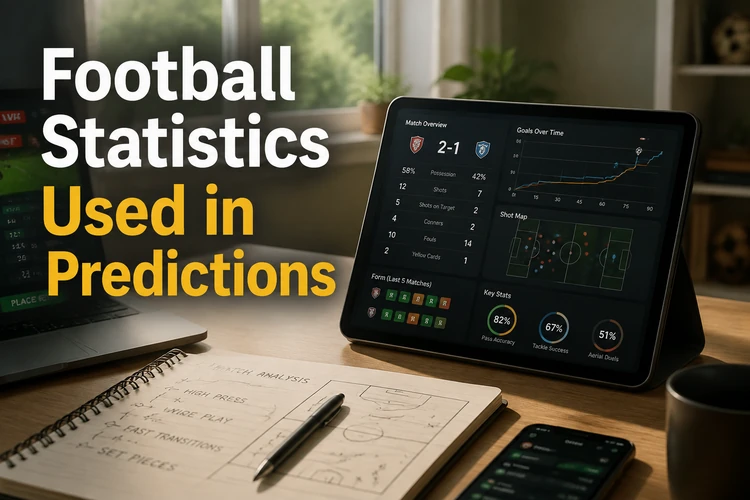
Attacking indicators include shots, shots on target, chances created, conversion rate, and xG. Defensive indicators include goals conceded, clean sheets, recoveries, and the quality of chances allowed. Possession can describe a team’s style, but high possession alone does not show whether it created dangerous opportunities.
Home and away splits are particularly practical. Some clubs create more chances at home but become passive on the road. Head-to-head records can reveal a recurring tactical matchup, yet old meetings should be given less weight when managers, formations, or key players have changed.
Player availability can alter the numbers quickly. The absence of a main striker may reduce finishing threat, while a missing central defender can affect both defensive stability and the team’s build-up. Suspensions, rotation, fixture congestion, and weather should be checked close to the start.
How to Interpret Predictions Correctly
No model can account for every event. A red card, referee decision, deflection, sudden injury, or exceptional individual performance can change a match beyond what historical data suggests. Treat a prediction as one input, not as an instruction.
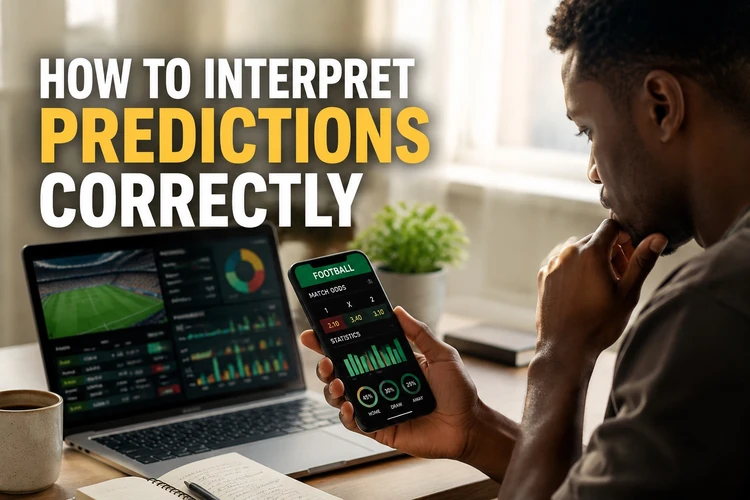
Comparing independent statistical views can expose uncertainty. Agreement may support an idea, while a sharp disagreement is a reason to investigate the data and reduce the stake or avoid the market. Odds should be read alongside the estimated probability, not treated as proof that an outcome is likely.
Before acting, ask whether the reasoning is clear, whether recent information has been checked, and whether the proposed amount fits a personal limit. Following a tip without understanding its assumptions makes it harder to evaluate mistakes and encourages emotional decisions after a loss.
Responsible Betting
Betting carries financial risk, and losses remain possible regardless of analytical quality. Use only money that can be lost without affecting food, housing, transport, bills, or other essential expenses. A prediction is an educational aid and cannot guarantee profit.
Set limits for both time and spending before starting. Do not chase losses by raising stakes, borrowing money, or treating a previous loss as a debt that must be recovered. If betting becomes stressful or interferes with daily life, stop and use the available responsible gambling guidelines for practical support.
Only individuals 18+ may participate in betting activities. Keeping accounts and devices away from minors is also part of responsible use.
FAQ
It is football analysis based on statistics, recent form, team information, and probability models. It offers structured insight for decision-making but cannot guarantee a match outcome.
A model processes factors such as goals, shots, xG, home and away performance, attacking strength, and defensive records to estimate probabilities for possible outcomes. The estimate remains uncertain because football contains unpredictable events.
Expected goals is a measure of chance quality. Each attempt receives an estimated probability based on details such as location, angle, type of assist, and defensive pressure. Adding those values gives an indication of the chances a team created or allowed.
Analysis may be updated as new fixtures, results, injuries, suspensions, or tactical information become available. The most recent team news should still be checked before considering any market.
No. Tips are assessments built from available information, while a match can change through a red card, injury, referee decision, or other unexpected event. Every bet involves the possibility of losing money.
Set a fixed budget using only disposable funds and choose a small, consistent stake rather than increasing it after losses. Recording bets and reviewing results over time can help maintain discipline, but it cannot eliminate risk.